
Ready to Elevate Your Product Experience ?
Whether you're launching a new product or refining an existing digital product, I'm here to help. Share the details about your project and I'll get back to you to work something out.
Retail & E-commerce · B2B
Designing an AI-assisted product onboarding experience that streamlined catalog operations from fragmented product data to confident publishing.
Role
Product Designer
PLatform
Internal Enterprise Web Application
Status
Shipped (2025)
Industry
Retail & E-commerce

Bass Pro Shops manages a large catalog of private-label and third-party products. I designed an AI-assisted product onboarding experience that helps merchandising teams validate product information, generate customer-ready content, review listings, and publish products through a structured workflow.
Bass Pro Shops manages a diverse product catalog that includes both private-label and third-party merchandise. Before a product can be published, merchandising teams need to validate product information, enrich missing details, create customer-facing content, and ensure every listing meets publishing standards.
As the catalog continues to grow, maintaining speed, consistency, and accuracy becomes increasingly challenging. The opportunity was to redesign this operational workflow into a unified AI-assisted experience.
Streamline the product onboarding workflow.
Reduce repetitive manual effort across merchandising tasks.
Improve consistency in product listings.
Accelerate publishing readiness without compromising quality.
Keep human review central to every publishing decision.
The platform serves as an operational workspace where merchandising teams prepare products for publication by combining product data, AI assistance, and structured review into a single workflow.
SFTP
ERP
PIM
WMS
Catalog
Legal
AI Product Onboarding
Basspro.com
Publishing a product wasn't a single action. It involved validating information, reviewing assets, creating customer-facing content, resolving missing data, and preparing listings for approval across multiple operational steps.
As product volume increased, these activities became repetitive and difficult to manage efficiently, creating an opportunity to redesign the workflow instead of optimizing individual tasks.
SFTP
ERP
PIM
Catalog
Legal
Validate Data
Create Content
Review
Publish
Product information originated from multiple enterprise systems, requiring users to consolidate and verify information before moving forward.
Teams repeatedly validated product attributes, reviewed assets, generated content, and followed up on missing information for every listing.
Missing details or incomplete product information often delayed the publishing process and required additional review cycles.
The objective wasn't simply to redesign an internal tool. It was to create a scalable product onboarding workflow that reduced operational effort while maintaining the quality and consistency required for enterprise merchandising.
Consolidate fragmented product information into a unified workflow.
Reduce repetitive manual effort across product onboarding.
Standardize how products are prepared before publication.
Improve the quality and consistency of customer-facing product listings.
Accelerate publishing readiness without compromising human review.
Data Validation
AI Detect missing or inconsistent information
Verify recommendations
Content generation
AI Generate titles, descriptions, and SEO content
Review and refine
Image quality checks
Identify potential quality issues
Approve final assets
Vendor communication
Draft contextual follow-up emails
Review and send
Product publishing
Support publishing readiness
Approve and publish
Design Principle
Validation
Content
Recommendations
Quality Checks
Review
Approval
Publishing
Instead of treating product publishing as a collection of disconnected tasks, I redesigned the experience into a structured workflow that guides merchandising teams from product data to publication.
Each stage has a clear objective, while AI supports repetitive tasks such as validation, content generation, and product review. Users remain in control throughout the entire process, ensuring every listing is reviewed before it goes live.
Product Data
Data Gathering
Content Generation
Preview & Edit
Publish
Basspro.com
Workflow Overview
Stage | Objective |
|---|---|
| Data Gathering | Consolidate and validate product information from multiple enterprise systems. |
| Content Generation | Generate customer-ready content using validated product data. |
| Preview & Edit | Review, refine, and verify product information before publishing. |
| Publish | Release approved listings with confidence. |
Every successful product listing starts with complete and reliable product information. The Data Gathering stage brings information from multiple enterprise systems into a single workspace, allowing merchandising teams to validate product details, identify missing information, review assets, and resolve issues before moving to content creation.
By establishing a trusted product foundation early, the rest of the workflow becomes faster, more consistent, and easier to review.

Product readiness progress
AI missing information detection
Image validation
AI-generated email assistance
Enterprise data sources
Consolidate product information from multiple enterprise systems
Detect missing product attributes with AI
Validate product images and supporting assets
Generate contextual vendor communication for missing information
Track product readiness before progressing to the next stage
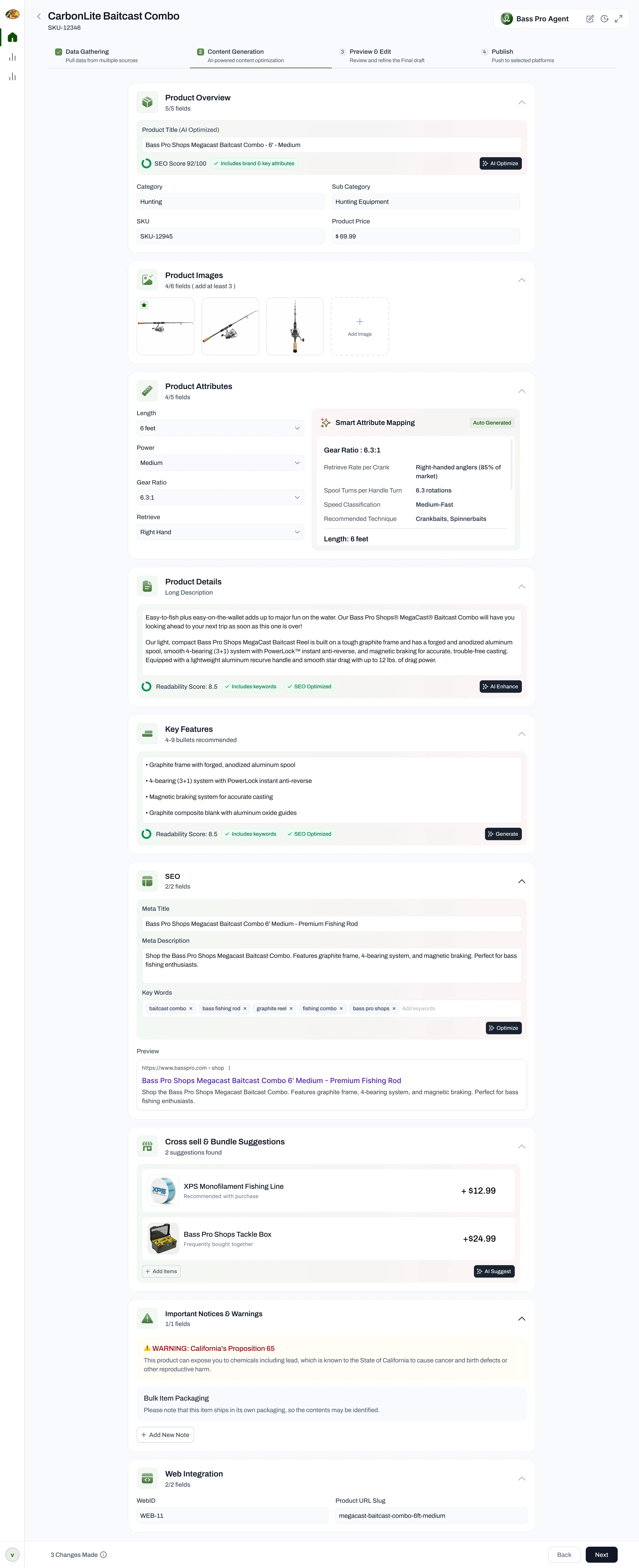
Once product information is validated, the workflow shifts from data preparation to content creation.
Using validated product attributes, AI generates product titles, descriptions, feature highlights, and SEO metadata, giving merchandising teams a strong starting point instead of a blank page. Every suggestion remains editable, allowing users to refine content before moving to the final review stage.
AI-generated product title
Product description editor
SEO metadata generation
AI Assistant for content refinement
Editable AI suggestions
Generate product titles and descriptions
Create SEO-friendly metadata
Produce feature highlights from product attributes
Refine content through contextual AI assistance
Edit and regenerate content before approval
The final stage brings together validated product data, AI-generated content, and merchandising expertise into one review experience.
Before publishing, users can review every recommendation, refine product content, verify assets, and ensure the listing meets business and merchandising standards.
Once approved, the product is ready to be published with confidence.
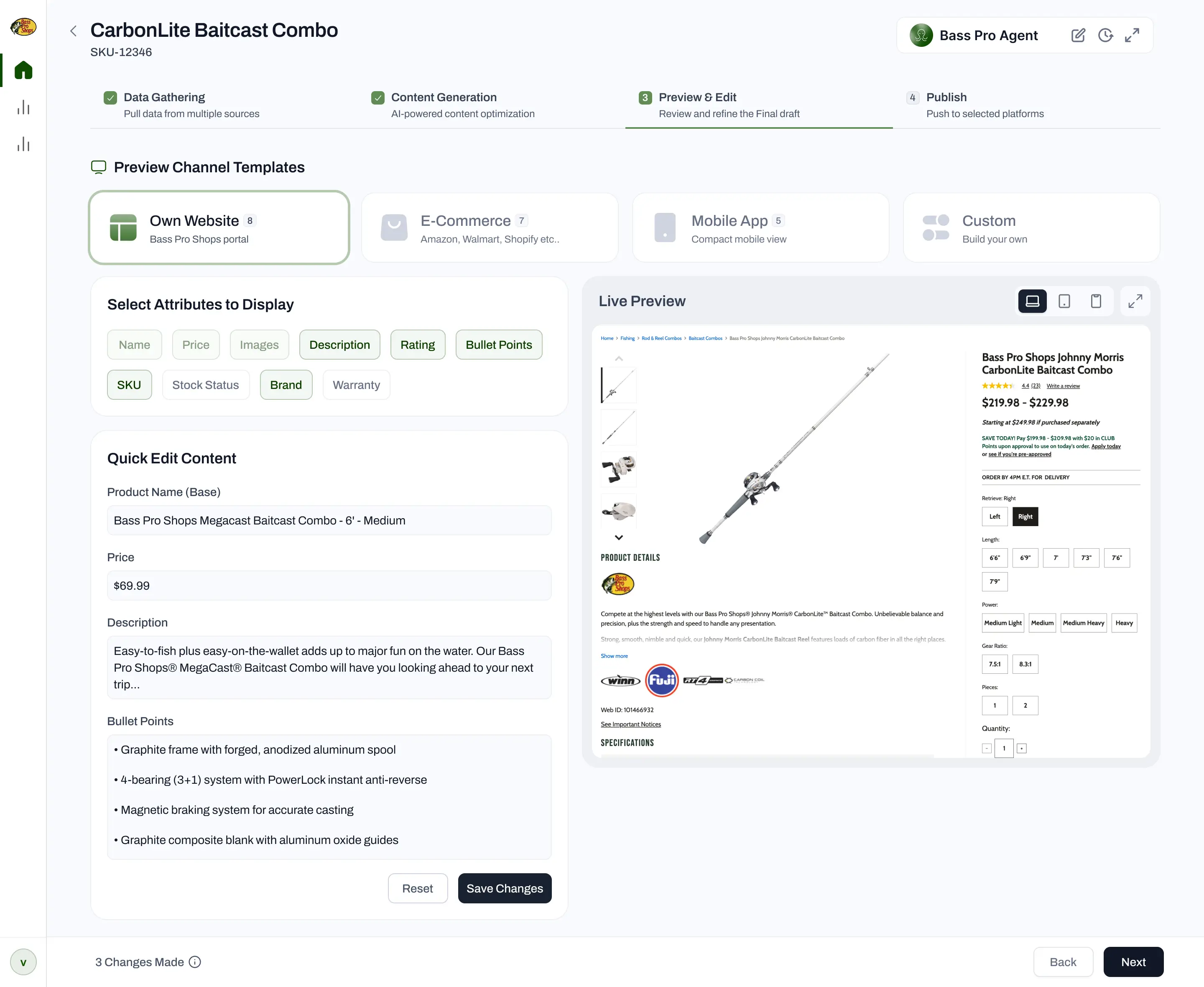
Product preview
Editable AI content
Final validation
Publish confirmation
Review AI-generated content before publishing
Edit product information and merchandising copy
Verify images and product assets
Preview the final customer-facing listing
Publish approved products through a guided workflow

The redesigned workflow transformed product onboarding from a collection of disconnected operational tasks into a structured AI-assisted experience. Rather than replacing human expertise, the platform reduced repetitive work and helped merchandising teams prepare products with greater consistency and confidence.
Unified fragmented product onboarding into a single operational workflow
Reduced repetitive merchandising tasks through contextual AI assistance
Standardized the journey from product data to publication
Improved publishing readiness through staged validation and review
AI integrated directly into the workflow instead of becoming a separate tool
Clear four-stage workflow reduced context switching across operational tasks
Human approval remained central to every business-critical decision
Built on top of existing enterprise systems without disrupting existing processes
End-to-end product experience design
Workflow architecture
AI interaction design
Information architecture
Enterprise UI design
Design system adaptation
Developer handoff and implementation support
Thank you
Whether you're launching a new product or refining an existing digital product, I'm here to help. Share the details about your project and I'll get back to you to work something out.